Key Points
- Strengthened ASEAN-Australia Relations: The summit commemorated the 50th anniversary of ASEAN-Australia dialogue, emphasizing a deep and ongoing partnership
- Strategic Agreements: Important documents such as the ASEAN-Australia Leaders’ Vision Statement and the Melbourne Declaration were endorsed, outlining future collaborative efforts
- Economic Cooperation: Discussions focused on enhancing economic ties through agreements like AANZFTA and RCEP, aiming to boost trade and investment between ASEAN countries and Australia
- Bilateral Engagements: Hun Manet held bilateral meetings with leaders from countries like the Philippines and Singapore, discussing topics ranging from trade and education to renewable energy and infrastructure
- Security and Crime Prevention: Emphasis was placed on tackling transnational crimes, including human trafficking and cybercrime, highlighting the need for collective action
- Investment Opportunities in Cambodia: The Prime Minister invited international companies to invest in Cambodia, promoting the country’s potential for economic development
Prime Minister Hun Manet’s trip to ASEAN-Australia Special Summit resulted in fruitful outcomes as he met with Australian Prime Minister Anthony Albanese and other regional leaders to promote further collaboration and partnerships.
Mr Hun Manet and his delegation attended the summit in Melbourne from Monday to Wednesday, and returned to Phnom Penh Wednesday night.
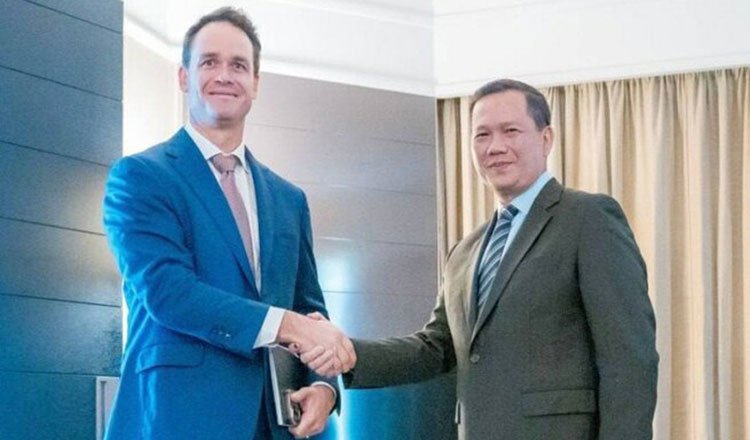
Mr Hun Manet met with his Australian counterpart, Anthony Albanese, on the sidelines of the ASEAN-Australia Special Summit, commemorating 50 years since Australia became ASEAN’s first Dialogue Partner.
Cambodia and Australia pledged to expand their bilateral relations and the Prime Ministers emphasised the importance of enhancing cooperation in trade, economy, education, employment and defence.
Mr Hun Manet suggested that relevant institutions of the two countries work more actively to increase the exchange of trade and investment, encourage university-to-university cooperation focusing on science, and agricultural research and development, as well as cooperation on Technical and Vocational Education and Training (TVET) and labour.
Jean-Francois Tain, Minister Delegate Attached to the Prime Minister in charge of Foreign Affairs and International Cooperation, said upon arrival at the Phnom Penh International Airport yesterday night in a press conference that Mr Hun Manet met with several ASEAN leaders to follow up on remaining issues.

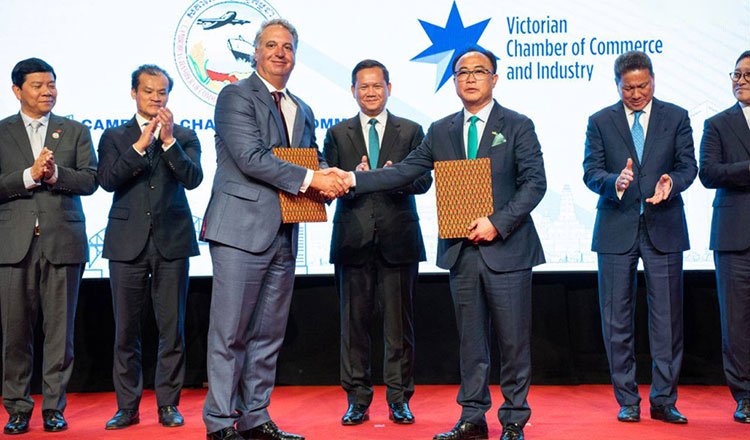
Victorian Chamber Chief Executive Paul Guerra (Third from L) and President of Cambodia Chamber of Commerce Kith Meng (Third from R) are seen with Prime Minister Hun Manet (C) after signing the MoU on Business Collaboration to promote trade, investment and economic cooperation between the two countries on Tuesday. AKP
“Samdech Thipadei met with ASEAN top leaders to follow up on the works between the Cambodian government and other countries’ governments to give a momentum on multiparty cooperation which is beneficial to Cambodia and the region,” Tain said.
He said that the Australian Prime Minister also praised Cambodia’s incredible fortitude and acknowledged the country’s journey from a tragic past to become a strong, peaceful, and politically stable nation.
He added that the Foreign Ministries of Australia and Cambodia had inked a bilateral agreement on air freight services.
The two nations have a history of collaboration in various sectors such as health, agriculture, infrastructure and education, as well as robust people-to-people connections.
According to Mr Hun Manet’s Cabinet, during the meeting, Albanese recalled the longstanding relationship between Cambodia and Australia, which spans over seven decades, predating Cambodia’s independence.
It said this highlights the positive relationship between the two countries, with mutual benefits accruing to their respective populations.
Albanese also expressed support and satisfaction with the discussions aimed at further strengthening and expanding cooperation between Cambodia and Australia.
The trade relationship between Australia and Cambodia is modest but experiencing rapid growth. In 2022, two-way trade in goods and services amounted to approximately $1.1 billion.
Key imports from Cambodia to Australia include gold, clothing, recreational travel items, footwear and travel goods and bags.
On the other hand, Australia’s main exports to Cambodia consist of education-related travel, cereal preparations, recreational travel items, coal and beef. Notably, the five-year trend in growth for Australia’s merchandise trade with Cambodia showed a 29% increase for imports and 20% increase for exports in 2022.
Mr Hun Manet also welcomed the signing of an agreement on air transport services, which is expected to boost tourism between Cambodia and Australia.
Ministry of Foreign Affairs and International Cooperation said in a statement issued yesterday that Mr Hun Manet touched on the need to further enhance people-to-people exchanges by highlighting that many Southeast Asian people have benefitted greatly from high-quality Australian education through Aus4ASEAN Scholarships, the Aus4ASEAN Digital Transformation and Future Skills Initiative and the Australia Awards Scholarships.
Mr Hun Manet also met with Christopher Luxon, Prime Minister of New Zealand.
ASEAN and Australia jointly adopted the “Melbourne Declaration” and the “ASEAN-Australia Leaders’ Vision Statement”, outlining their commitment to deepening cooperation, addressing regional challenges, and promoting mutual prosperity and stability after a three-day gathering in Melbourne.
The leaders shared their vision for the region and explored avenues to enhance practical cooperation. This included deepening ties between the respective peoples and economies, as well as bolstering collaboration on education and environmental issues.
Australia is also committing an additional allocation of AUD 222.5 million (about $145 million) to strengthen the resilience and prosperity of the Mekong sub-region through the Mekong-Australia Partnership (MAP).
Mr Hun Manet also held bilateral meetings with Singaporean Prime Minister Lee Hsien Loong, Indonesian President Joko Widodo, Philippines’s President Ferdinand R. Marcos Jr. and Vietnamese Prime Minister Pham Minh Chinh on the sidelines of the ASEAN-Australia Special Summit to mark the 50-year partnership.
Mr Hun Manet met Lee Hsien Loong in Melbourne on March 5.
Both leaders discussed the cooperation in key areas such as politics, trade and economy, tourism, energy security, and defence and security. They also exchanged views on the promotion of cooperation on high-level exchange visits, connectivity, and people-to-people relations.
In the political sector, the two leaders noted the importance and benefits of resuming political consultations and agreed to push for a second round of political consultations between Cambodia and Singapore in the near future.
For trade and economy, the two leaders agreed to promote better relations by encouraging cooperation between relevant ministries and institutions of the two countries for initiatives and specific actions.
The two leaders also agreed to boost defence and security cooperation, which contributes to the fight against cybercrime and online gambling.
Mr Hun Manet met with Indonesian President Joko Widodo and reaffirmed their commitments during a bilateral meeting on the sidelines of the ASEAN-Australia Special Summit in Melbourne on Tuesday.
During their discussions in Melbourne, Mr Hun Manet and Joko identified key areas for strengthening and expanding cooperation between Cambodia and Indonesia, including diplomacy, economy and trade, tourism and security.
Trade between Indonesia and Cambodia amounted to $961.2 million last year, marking a significant increase of 21.9% up from the $788.3 million recorded in 2022.
Furthermore, both leaders agreed to continue promoting cooperation in key sectors while exploring new opportunities for collaboration in other prospective fields.
According to an Indonesian presidential press bureau statement, both leaders engaged in discussions regarding cooperation on food security, specifically focusing on rice imports from Cambodia.
Joko expressed keen interest to renew the bilateral Memorandum of Understanding (MoU) on rice trade. Also, he took the opportunity to propose another MoU concerning a counter-trade mechanism, aiming to establish mutual agreement on the price and volume of imported rice between both nations.
Mr Hun Manet and the President of the Philippines Ferdinand R. Marcos Jr. discussed a wide range of close bilateral issues, including defence, tourism, trade and double taxation, among other topics.
According to the Philippines’s Presidential Communications Office (PCO), during the meeting the leaders discussed the double taxation issue between the two countries.
“We are working very hard on the issue of double taxation between our two countries,” Marcos Jr. told Mr Hun Manet.
“And I just wanted to assure you that we are working on that… because if we are going to talk about increased trade between Cambodia and the Philippines, that has to be sorted out,” he added.
In response, Mr Hun Manet said that the Cambodian government will also address the issue, as Cambodia is actively pursuing similar initiatives with other countries to enhance trade and investment mechanisms.
The discussions on the double taxation agreement between the Philippines and Cambodia began in Manila in 2018, with continued efforts in subsequent years.
Mr Hun Manet expressed his interest in further discussions on connectivity and increasing the number of tourists travelling between Cambodia and the Philippines.
Mr Hun Manet met with Vietnamese Prime Minister Pham Minh Chinh on March 6.
Vietnam and Cambodia will enhance economic connectivity, especially transport connectivity, between the two countries, creating the prerequisite to increase bilateral cooperation in other fields.
Chinh congratulated Cambodia on its sound economic development achievements recorded in recent times. The two Prime Ministers expressed their joy at the recent positive and stable development of Vietnam and Cambodia relations, noting that leaders of the two countries maintain regular visits and high-level contacts, while bilateral cooperation mechanisms prove to be effective.
The two sides also agreed to coordinate and deploy existing mechanisms on national defence and security, and make further efforts to complete the 16% remaining workload of border demarcation.
Both leaders exchanged views on preparations for state visits of Vietnamese President Vo Van Thuong to Cambodia and King Norodom Sihamoni to Vietnam during the second quarter of this year.
On boosting economic ties, Mr Hun Manet and his Vietnamese counterpart shared the view that relevant institutions should be further encouraged to achieve the two-way trade target of $20 billion in the near future.